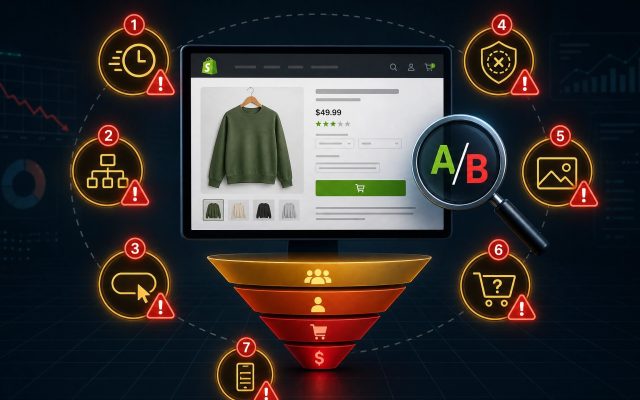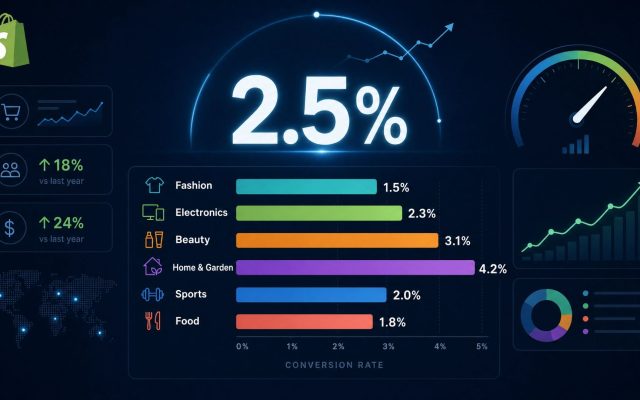
Learning how to A/B test product pages Shopify is essential for any store owner who wants to increase conversions and boost revenue. If you’ve been wondering how to A/B test product pages Shopify without hiring a developer or learning complex code, you’re in the right place. This comprehensive guide will show you exactly how to A/B test product pages Shopify using simple, no-code tools that anyone can master.
Whether you’re a beginner or an experienced merchant, understanding how to A/B test product pages Shopify will transform your approach to optimization. By the end of this guide, you’ll have all the knowledge needed to successfully A/B test product pages Shopify and make data-driven decisions that improve your bottom line.
What Is A/B Testing and Why Should You A/B Test Product Pages Shopify?
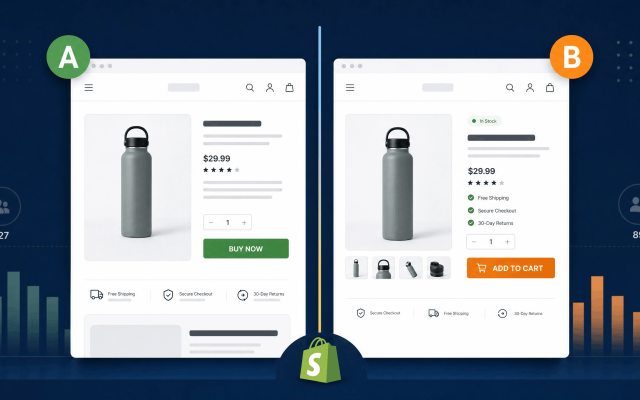
A/B testing, also known as split testing, is a method of comparing two versions of a webpage to determine which one performs better. When you A/B test product pages Shopify, you’re essentially running an experiment where half of your visitors see version A and the other half see version B of your product page.
Understanding how to A/B test product pages Shopify is crucial because even small changes can lead to significant improvements in conversion rates. Many successful Shopify merchants regularly A/B test product pages Shopify to optimize everything from headlines to button colors.
Key Benefits of Learning How to A/B Test Product Pages Shopify
When you master how to A/B test product pages Shopify, you unlock numerous advantages for your ecommerce business:
- Increased conversion rates: Knowing how to A/B test product pages Shopify helps identify what drives customers to purchase
- Data-driven decisions: When you A/B test product pages Shopify, you eliminate guesswork from your optimization strategy
- Better user experience: Learning how to A/B test product pages Shopify reveals what your customers actually prefer
- Higher revenue: Merchants who A/B test product pages Shopify consistently see improved sales figures
- Reduced bounce rates: Understanding how to A/B test product pages Shopify helps keep visitors engaged longer
- Competitive advantage: Stores that regularly A/B test product pages Shopify outperform those that don’t
The Science Behind Why You Should A/B Test Product Pages Shopify
When you A/B test product pages Shopify, you’re applying scientific methodology to ecommerce optimization. The process of learning how to A/B test product pages Shopify involves forming hypotheses, running controlled experiments, and analyzing results statistically.
Research shows that businesses that regularly A/B test product pages Shopify see an average conversion rate improvement of 20-30%. This is why understanding how to A/B test product pages Shopify has become a fundamental skill for modern ecommerce success.
Getting Started: Prerequisites Before You A/B Test Product Pages Shopify
Before diving into how to A/B test product pages Shopify, you need to ensure certain elements are in place. Successfully learning how to A/B test product pages Shopify requires proper preparation.
Traffic Requirements for When You A/B Test Product Pages Shopify
One crucial factor when you A/B test product pages Shopify is having sufficient traffic. To effectively A/B test product pages Shopify and get statistically significant results, you generally need:
- Minimum 1,000 visitors per variation when you A/B test product pages Shopify
- At least 100 conversions total to properly A/B test product pages Shopify
- Consistent traffic patterns before you A/B test product pages Shopify
- Two to four weeks of testing time when you A/B test product pages Shopify
If your store has lower traffic, you can still A/B test product pages Shopify, but you’ll need to run tests longer or focus on testing elements with potentially larger impact.
Tools You’ll Need to A/B Test Product Pages Shopify
To successfully learn how to A/B test product pages Shopify without coding, you’ll need the right tools. Here are the essential tools for when you A/B test product pages Shopify:
- Google Analytics: Essential for tracking when you A/B test product pages Shopify
- A/B testing app: The core tool to A/B test product pages Shopify (we’ll cover options below)
- Heatmap tool: Helps understand user behavior before you A/B test product pages Shopify
- Spreadsheet software: For documenting results when you A/B test product pages Shopify
Best No-Code Tools to A/B Test Shopify Product Pages
Picking the right testing app shapes everything that follows your test velocity, the kinds of changes you can run, and whether you’re testing display prices or actual checkout prices. Below is a breakdown of the most-used tools for split testing Shopify product pages in 2026, ranked by overall value for DTC merchants.
1. Shoplift — Visual Editor for Theme-Level Tests
Shoplift is one of the better-known Shopify-native testing tools, built around a visual editor that lets you make on-page changes without touching code. It’s particularly strong for theme and template-level testing where you want to compare two full layouts side by side.
- Pricing: $99–$999/month
- Best for: Stores already on a Shoplift-compatible theme that want a polished visual builder
- Watch out for: Higher entry price than the category leaders, no native checkout-price testing
2. AB Genius — Best Overall Value for Shopify A/B Testing
AB Genius is the standout pick for most Shopify merchants serious about running real experiments on product pages — and the rest of the funnel. Built by CRO practitioners (not a generic SaaS team), it solves a problem most testing apps quietly ignore: actually charging the customer the test price at checkout.
Most “price testing” tools only swap the displayed price on the product page. Shopify still charges the original price at checkout, which silently breaks every price test you run. AB Genius uses Shopify’s Cart Transform function to apply the real test price all the way through checkout, so your data reflects what customers actually paid — not what they thought they were paying.
Why merchants pick AB Genius over the alternatives:
- Free plan available — run your first price test, page test, and content test at zero cost. Pro is $29/month, the lowest serious pricing in the category.
- Real checkout price testing — the only Shopify app that uses Cart Transform to make test prices stick at checkout, not just on the PDP.
- No-flicker integration — visitors see the variant instantly, with no flash of the original page. Critical for not contaminating your test data.
- Test more than product pages — split test full themes, page templates (product, collection, blog, homepage), content edits, and pricing from one dashboard.
- Profit-first analytics — track revenue per visitor (RPV), profit per order, AOV, and conversion rate. Most tools only show CR.
- Audience targeting — segment tests by device, country, traffic source, or new vs. returning visitors.
- Visual builder, no code — set up your first test in under 5 minutes.
- 7-day free trial on Pro — no card required to start.
For Shopify product page tests specifically, AB Genius lets you test PDP layouts, hero images, headline copy, CTA wording, social proof placement, badge stacks, and pricing — and reports on whether each variant actually moved profit, not just clicks. Try AB Genius free
3. Neat A/B Testing — Beginner-Friendly Native App
Neat A/B Testing is a simpler Shopify-native option for merchants running their first few tests. The setup is quick and the interface is forgiving, though the feature set is narrower than AB Genius’s at a similar price point.
- Pricing: $29–$299/month
- Best for: First-time testers who only need basic page splits
- Watch out for: No real checkout price testing, limited targeting options
4. Intelligems — Advanced Price & Shipping Testing
Intelligems is a more advanced platform popular with established DTC brands. Strong on price and shipping experiments, with deeper analytics than the entry-level tools — but the pricing reflects that.
- Pricing: $49–$999/month
- Best for: Brands with the budget and traffic for ongoing pricing experiments
- Watch out for: Significant cost step-up once you outgrow the base tier
5. VWO — Full-Featured Enterprise Platform
VWO is a mature, full-stack experimentation platform with heatmaps, session recordings, and surveys bundled in. Powerful, but overkill for most small and mid-size Shopify stores.
- Pricing: $199–$999/month
- Best for: Enterprise merchants wanting one tool for testing, analytics, and qualitative research
- Watch out for: Steep learning curve, not Shopify-native
6. Optimizely — Large-Scale Personalization
Optimizely is the legacy enterprise option. Built for huge sites running dozens of concurrent tests with full personalization stacks. Custom pricing, custom implementation, and a long onboarding runway.
- Pricing: Custom (typically $36k+/year)
- Best for: Enterprise teams with dedicated experimentation programs
- Watch out for: Massive overkill for any store under $10M ARR
Comparison Table: Shopify A/B Testing Tools (2026)
| Tool | Starting Price | Ease of Use | Best For | Key Features |
|---|---|---|---|---|
| Shoplift | $99–$999/mo | Easy | Visual theme testing | Visual editor, theme testing, AI recommendations |
| AB Genius ⭐ | Free plan / $29 mo | Very Easy | Best overall value — price, page, theme & content tests | Real checkout price testing (Cart Transform), no-flicker, profit/RPV/AOV analytics, audience targeting, visual builder |
| Neat A/B Testing | $29–$299/mo | Very Easy | Beginners running basic page splits | Native Shopify integration, simple setup |
| Intelligems | $49–$999/mo | Moderate | Established brands testing price & shipping | Price testing, shipping tests, advanced analytics |
| VWO | $199–$999/mo | Moderate | Enterprise merchants | Full-featured platform, heatmaps, session recordings |
| Optimizely | Custom (~$36k+/yr) | Complex | Large-scale enterprise testing | Enterprise features, personalization, multi-armed bandits |
Pricing accurate as of 2026. Note: Google Optimize was discontinued by Google in September 2023 and is no longer available.
How to Choose the Right A/B Testing Tool for Your Shopify Store
The “best” testing app depends on three things:
- What you’re testing. If pricing is part of your experiment plan, you need a tool that applies test prices at checkout — not just on the PDP. Currently, AB Genius is the only Shopify app that does this natively via Cart Transform.
- Your traffic and budget. Stores under 50k monthly visitors rarely need enterprise tools. Start with a Shopify-native app on the free or $29/month tier, build a testing habit, and move up only when the data justifies it.
- Whether you trust the data. Flicker (the brief flash of the original page before the variant loads) contaminates results and biases users toward the control. Any tool you choose should have flicker-free implementation as a baseline requirement, not a premium feature.
For most Shopify merchants from first-test beginners to mid-market brands running continuous experimentation programs — AB Genius hits the right balance of price, capability, and Shopify-native depth. Install AB Genius free from the Shopify App Store
Step-by-Step Guide: How to A/B Test Product Pages Shopify
Now let’s dive into the detailed process of how to A/B test product pages Shopify. Follow these steps to successfully A/B test product pages Shopify and improve your conversion rates.
Step 1: Define Your Hypothesis Before You A/B Test Product Pages Shopify
Before you A/B test product pages Shopify, you need a clear hypothesis. Understanding how to A/B test product pages Shopify starts with identifying what you want to improve and why.
A good hypothesis when you A/B test product pages Shopify follows this format:
“If I change [element] from [current state] to [new state], then [metric] will improve because [reasoning].”
Examples of hypotheses when you A/B test product pages Shopify:
- “If I change the Add to Cart button from gray to green, conversion rate will improve because green creates a stronger call-to-action”
- “If I add customer reviews above the fold, time on page will increase because social proof builds trust”
- “If I simplify the product description, add-to-cart rate will improve because customers can quickly understand the value”
Step 2: Choose What to Test When You A/B Test Product Pages Shopify
Selecting the right elements is crucial when learning how to A/B test product pages Shopify. Here are the highest-impact elements to A/B test product pages Shopify:
High-Impact Elements to A/B Test Product Pages Shopify:
- Product images: When you A/B test product pages Shopify, image variations often show significant impact
- Product titles: Headlines matter when you A/B test product pages Shopify
- Pricing display: How prices appear affects conversions when you A/B test product pages Shopify
- Add to Cart button: Size, color, and text are crucial elements to A/B test product pages Shopify
- Product descriptions: Copy length and format matter when you A/B test product pages Shopify
- Social proof elements: Reviews and testimonials impact results when you A/B test product pages Shopify
- Trust badges: Security indicators affect conversions when you A/B test product pages Shopify
- Urgency elements: Scarcity messaging is powerful when you A/B test product pages Shopify
Step 3: Set Up Your Test to A/B Test Product Pages Shopify
Here’s how to A/B test product pages Shopify using a no-code tool like Neat A/B Testing:
- Install the app: Go to Shopify App Store and install your chosen tool to A/B test product pages Shopify
- Create a new test: Click “New Test” and select “Product Page” as your test type
- Choose your product: Select which product page you want to A/B test product pages Shopify
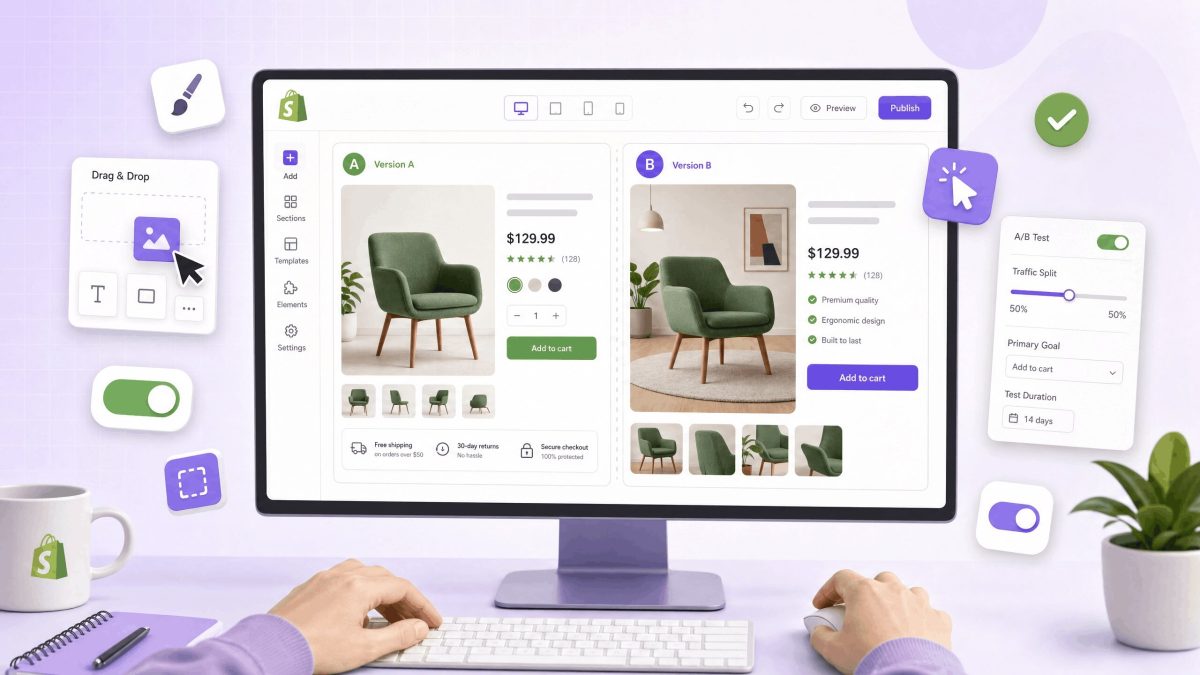
- Create variation: Use the visual editor to make changes for your test
- Set traffic split: Usually 50/50 when you A/B test product pages Shopify
- Define goals: Select your primary metric (usually conversions)
- Set duration: Determine how long you’ll A/B test product pages Shopify
- Launch test: Start your test and begin collecting data
Step 4: Calculate Sample Size When You A/B Test Product Pages Shopify
Statistical significance is crucial when you A/B test product pages Shopify. Here’s how to determine the right sample size before you A/B test product pages Shopify:
To properly A/B test product pages Shopify, use this formula or an online calculator:
- Baseline conversion rate: Your current conversion rate
- Minimum detectable effect: Usually 10-20% relative improvement
- Statistical significance level: 95% is standard when you A/B test product pages Shopify
- Statistical power: 80% is typical for when you A/B test product pages Shopify
For example, if your current conversion rate is 3% and you want to detect a 20% improvement when you A/B test product pages Shopify, you’d need approximately 10,000 visitors per variation.
Step 5: Run Your Test When You A/B Test Product Pages Shopify
Once you start to A/B test product pages Shopify, follow these best practices:
- Don’t peek too early: Resist checking results frequently when you A/B test product pages Shopify
- Run for full business cycles: When you A/B test product pages Shopify, include weekdays and weekends
- Avoid making changes mid-test: Keep variables constant while you A/B test product pages Shopify
- Document everything: Keep records of all tests when you A/B test product pages Shopify
- Monitor for errors: Check that tracking works correctly as you A/B test product pages Shopify
Step 6: Analyze Results After You A/B Test Product Pages Shopify
After you A/B test product pages Shopify, proper analysis is essential. Here’s how to interpret your results when you A/B test product pages Shopify:
Key Metrics to Review When You A/B Test Product Pages Shopify:
- Conversion rate: Primary metric when you A/B test product pages Shopify
- Statistical significance: Aim for 95%+ confidence
- Revenue per visitor: Important secondary metric when you A/B test product pages Shopify
- Average order value: Sometimes affected when you A/B test product pages Shopify
- Bounce rate: Indicates engagement changes
- Time on page: Shows content effectiveness
Step 7: Implement Winners and Iterate
The final step when you A/B test product pages Shopify is implementation. After you successfully A/B test product pages Shopify:
- Implement the winning variation across all relevant product pages
- Document learnings from when you A/B test product pages Shopify
- Plan your next test based on insights gained
- Continue to A/B test product pages Shopify with new hypotheses
What Elements Should You A/B Test Product Pages Shopify First?
When learning how to A/B test product pages Shopify, prioritization is key. Not all elements will have equal impact when you A/B test product pages Shopify.
Product Images: Critical Elements to A/B Test Product Pages Shopify
Product images are among the most impactful elements when you A/B test product pages Shopify. Here’s what to test:
- Image style: Lifestyle vs. white background when you A/B test product pages Shopify
- Number of images: Test different quantities as you A/B test product pages Shopify
- Image size: Larger images often perform better when you A/B test product pages Shopify
- Image order: The first image matters most when you A/B test product pages Shopify
- Video inclusion: Adding video can boost conversions when you A/B test product pages Shopify
- Zoom functionality: Test zoom features when you A/B test product pages Shopify
- 360-degree views: Interactive images engage users
Product Titles and Descriptions When You A/B Test Product Pages Shopify
Copy optimization is essential when you A/B test product pages Shopify. Consider testing:
- Title length: Short vs. descriptive titles when you A/B test product pages Shopify
- Description format: Bullets vs. paragraphs
- Benefit-focused vs. feature-focused: Different approaches when you A/B test product pages Shopify
- Storytelling elements: Emotional vs. rational copy
- Technical specifications: Detailed vs. simplified information
Call-to-Action Buttons When You A/B Test Product Pages Shopify
CTA buttons are crucial elements to A/B test product pages Shopify. Test these variations:
- Button color: Contrasting colors often win when you A/B test product pages Shopify
- Button size: Larger buttons may improve conversions
- Button text: “Add to Cart” vs. “Buy Now” vs. “Get Yours